According to the Scotch Whisky Association, there are 156 whisky distilleries in Scotland, the spirit contributed £7.1bn to the UK economy in 2022 and exports in 2025 were worth £5.36bn, based on the latest available figures. More than 41,000 people (scotch-whisky.org.uk) are employed in the Scotch whisky industry in Scotland and an estimated 22m casks lie maturing in Scottish warehouses.
The new Port of Leith Distillery (leithdistillery.com) adds to this remarkable collection. Clad in black corrugated steel and standing tall on the Leith harbourside, Edinburgh’s historic port area, the distillery overlooks the quayside, where whisky was traditionally matured and bottled.
“The fact it’s a modern looking building reflects our outlook for the business,” says co-founder Ian Stirling. “Of course, we’ve embraced the rich history and traditions of whisky, but we’ve added innovation, too.”
The home of whisky
Stirling, and his business partner Paddy Fletcher, grew up in Edinburgh before moving to London to start their careers. Stirling worked in the drinks industry, while Fletcher was an accountant, specialising in tech startups.
The lifelong friends stayed in touch, sharing a love of whisky, and when in 2013 they discovered there wasn’t a working whisky distillery in their home town, an idea quickly took shape.
By 2020, both had returned to the Scottish capital, and using their own entrepreneurial expertise, as well as tapping into a business ecosystem designed to nurture innovation, the Port of Leith Distillery was born.
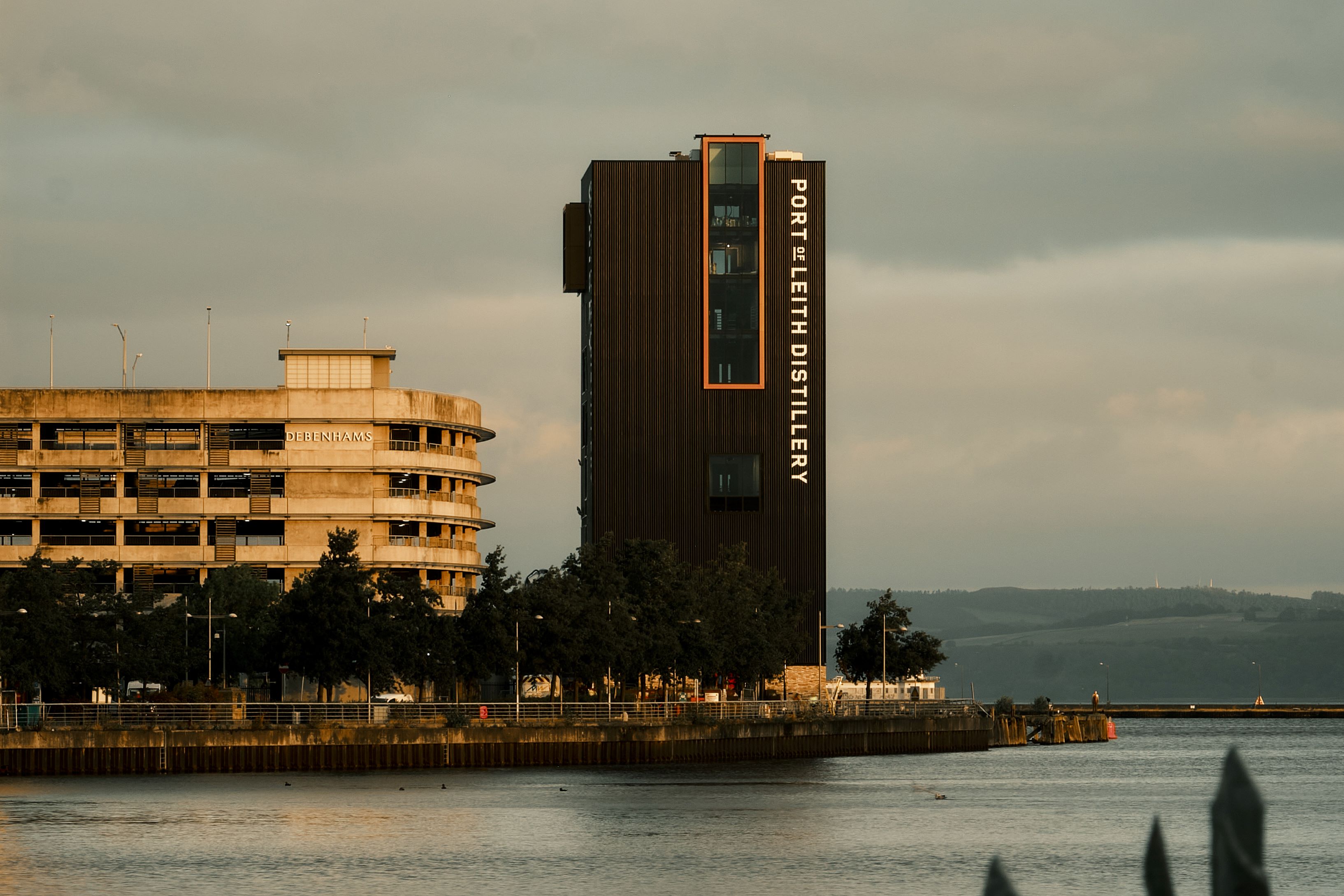 The black-clad building makes for a striking addition to the Leith waterfront. Photograph: AwAyeMedia
The distinctive nine-storey building is the UK’s first vertical distillery, and the tallest in the world. Avoiding the traditional horizontal layout, grain is first milled and mashed at the top of the building, before passing down through fermentation tanks and a final distillation stage on the ground floor.
“It’s certainly stopped a few people in their tracks,” says Stirling, of the landmark building, which architects had to fit into an already crowded urban landscape. “It soon became clear that the only way to build was going to be up,” he says. “I guess it’s all part of the can-do attitude in Scotland – we love a challenge.”
A complex alchemy
The company has taken this innovative thinking into its whisky production, with Stirling keen to push boundaries and try new ideas. With funding and support from Innovate UK (ukri.org), the UK’s innovation agency, he connected with Edinburgh’s Heriot-Watt University and its International Centre for Brewing and Distilling.
Through a Knowledge Transfer Partnership (iuk-ktp.org.uk), a government-funded scheme that brings universities and businesses together to work on development projects, Stirling says: “We were able to leverage world-class expertise on our own doorstep, leading to a partnership that most new startups could only dream of.”
A three-year research project followed, investigating the impact of different yeast types on whisky. For the last 50 years, whisky has predominantly been made using distiller’s yeast, a specialised strain that is highly efficient at turning sugars into alcohol. But Stirling wanted to shift the focus from efficiency to flavour and go back to recipes that used brewer’s yeast instead.
“Brewing is not always about a high alcohol content, it’s often more about flavour,” he says. “One of the key things about Scotch whisky is its ability to take on and retain so many different flavours; there’s a complex alchemy at play.
“We found that brewer’s yeast made far more interesting and intense spirits. I guess what we’ve done is married innovation with heritage to create something new and distinctive,” he adds. Alongside research and innovation, the company has worked to establish local supply chains – sourcing its base ingredients from within Scotland.
In a competitive market, the Port of Leith Distillery is set to stand out with a range of unique and distinctive flavour profiles, derived both from their innovative new make spirit and the variety of casks used for maturation.
The first batch of single malt whisky won’t mature until 2027, so to fill the time, the distillery has released a range of blended, single grain, and single cask whiskies under the Leith Bond range. Table Whisky is a single grain whisky, distilled elsewhere in Edinburgh, and matured in new oak and PX sherry casks to enhance its rich flavours. The whisky is designed to be accessible, pushing aside preconceptions of what a whisky should and shouldn’t be.
Stirling (and business partner Paddy) also have a second Leith distillery, this business produces a classic London dry gin, Lind & Lime (lindandlime.com). Last year the distillery shipped nearly 115,000 bottles to 27 global markets.
Global warmth for Brand Scotland
Scotland’s close knit and supportive ecosystem (migrationservice.scotland.org) has been at the heart of the distillery’s evolution, and Edinburgh itself has provided a rich pipeline of talent. Head of whisky operations, Vaibhav Sood, is an alumnus from Heriot-Watt, and a string of highly trained graduates have joined the company from the university’s brewing and distilling course.
The Brand Scotland partnership has been right behind them every step of the way. Working with VisitScotland (visitscotland.com), the distillery has proved a popular addition to Edinburgh’s excellent range of tourist attractions and last year more than 30,000 people took a guided tour.
 The distillery’s top-floor bar showcases its distinctive range of flavours. Photograph: AwAyeMedia
Stirling has been able to call on the support of other Brand Scotland partners too, among them Scottish Enterprise (scottish-enterprise.com) and Scotland Food & Drink (foodanddrink.scot), who, he says, have helped to connect the business with investors and importers from all round the world.
“Scotland is an exciting place to do business, and there’s a real collective effort and willingness to help companies succeed,” says Stirling.
In 2025, Scotch whisky was exported to about 163 countries and territories around the world, according to the Scottish Whisky Association (scotch-whisky.org.uk). “There’s an incredible warmth towards Scotland,” Stirling adds. “When you meet new buyers and importers, you immediately have an advantage, it’s extraordinary. That affection for Scotland, and the perception that the goods we produce are of such high quality, is incredibly powerful; it opens doors before you’ve even put your product on the table.”
This article was originally published on theguardian.com as part of a paid commercial partnership called Scotland: For the head, heart and the spirit for Brand Scotland.
Header photo caption: Old friends united by a love of whisky: Paddy Fletcher and Ian Stirling, founders of the Port of Leith Distillery. Photograph: AwAyeMedia
Photo credits: AwAyeMedia